Counterweight
The Counterweight of Reality in a World of Disequilibrium

Reality is that which, when you stop believing in it, doesn’t go away.— Philip K. Dick
This week’s note will be a rather short one, as price action in markets is still largely being driven by the ongoing war between the United States, Israel, and Iran. I discussed two possible scenarios two weeks ago, and the main takeaway remains that a quick and decisive victory for the United States and Israel is very unlikely to materialize.
However the war develops from here, one thing is already clear: there is a great deal of noise in current market price action. Trump’s constant comments on the war do not help either, as they often contradict one another. The US president is risking a point at which markets simply stop believing him. For now, the signs still point toward further escalation, especially after Israel bombed facilities linked to Iran’s South Pars natural gas field.
Apart from that, it was a busy week for central banks, with the Fed, the BOJ, and the ECB all holding policy meetings. As I write this on Thursday, I will only discuss the Fed decision in this piece and return to the others next week, provided there is anything of real interest to add.
If I had to sum up current market price action in one word, however, it would be: “Disequilibrium.”
OIL VS. OIL – Is The Plan Working?
Oil and energy remain major drivers of current price action, and given that Israel — and to some extent the United States — appear to be running into what Professor Robert Pape of the University of Chicago calls the “escalation trap,” it is difficult to say when markets will finally begin to look through the storm.
Yet much of the discussion in markets still revolves around the theory I discussed two weeks ago: that this war is merely one scene in a broader geopolitical struggle over control of major energy chokepoints, with the United States on one side and China and Russia on the other.
I have little to add here to the broader thesis itself — interested readers can find my view in “Another Hero Lost” — but I do want to comment on one particular claim made by proponents of that view, and one that is now increasingly visible in market discourse: the alleged end of the law of one price for energy.
In theory, the law of one price holds that globally traded commodities such as energy should not diverge materially in price across regions, because arbitrage will eventually force prices back toward alignment. Although the law is more theoretical than empirical, the current price action in oil markets suggests a severe breakdown in convergence. Oil prices in Oman are at $150/barrel, while Brent is at $114/barrel and WTI is at $97/barrel.
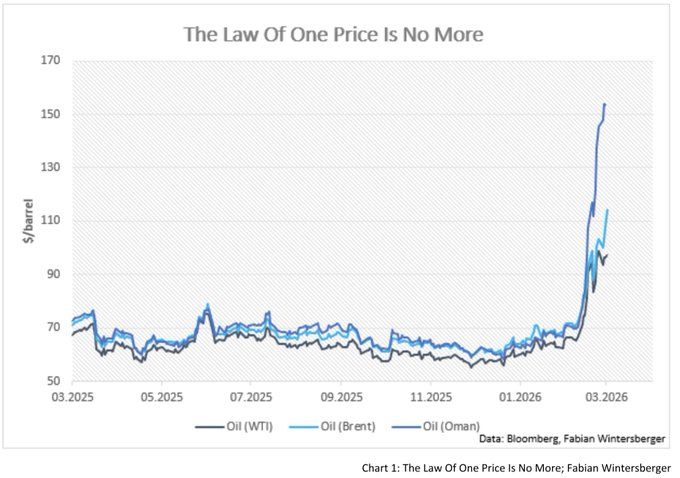
But back to the thesis: the thesis claims that the goal of this fight for supremacy over global supply chokepoints is directed at achieving exactly this: different prices for one commodity in different places. Now, with the war, prices for energy in Asia, Europe, and the Middle East are rising faster than in the US, as US dependence on oil and gas passing through the Strait of Hormuz is lower. At least that is what the geopolitical and global macro analysts who propose the theory claim.
While I would not be surprised if Trump was told such a story to sell him the war more effectively than “we have to defend Israel” or “Iran is a threat to the US” — which it never was — I am highly skeptical that this is a “multiple equilibrium” in the making and rather see it as a sign of disequilibrium. I see it as a disequilibrium that is getting bigger and will discharge at one point.
Besides the fact that the proclaimed “US energy independence” is somewhat of a stretch — the US drills light crude but still needs heavy crude for refining — oil remains a fungible commodity that goes to the highest bidder. The fact that oil is expensive in one part of the world due to war only increases demand for oil produced in other parts of the world. If no oil is flowing from the Middle East, buyers have to go somewhere else.
The question, then, is why the divergence between oil prices is so wide today. One can only speculate, but there have been rumors — not entirely unusual in stressed markets — that the US Treasury has at least considered trying to suppress front-end oil prices through large futures trades, though Bessent has denied that such intervention is taking place.
In theory, the mechanism is straightforward: sell large volumes of near-dated futures while buying longer-dated contracts. That could put downward pressure on the front end and flatten the curve.
The problem, however, is that such a strategy can only lean against market pricing for a while. If the underlying physical supply shock persists, the trade does not solve the problem; it merely tries to mask it. In that case, fundamentals eventually reassert themselves, the intervention becomes costly to maintain, and the market can snap back violently.
Another explanation is that traders still do not expect the war to continue for much longer and are actively trading the price lower. Both theories suffer from the same problem: while the Oman price appears to reflect immediate physical tightness more directly, futures prices are driven either by active intervention or by speculation and expectations. If these turn out to be wrong, the price adjusts to reality. This is the disequilibrium discharging.
And keeping in mind that the escalation trap is still in full force, I remain skeptical that the ongoing verbal interventions will work forever and that futures prices are more likely to adjust to physical prices than the other way around. In a world of accelerating consumer prices and slowing growth — stagflation — oil prices remain in a bullish trend. That is also why I doubt that the alleged US “plan” will work out as intended.
To sum up, the current market environment and elevated volatility are signs of disequilibrium, and that disequilibrium is beginning to reshape expectations and will likely force a significant repricing across asset classes.
Germany’s Infrastructure Spending: Broken Budget, Broken Infrastructure
One of the regions most affected by the current disequilibrium is Europe, and Germany in particular. The longer the crisis continues, the more it increases the risk Friedrich Merz took when his government chose to borrow €1 trillion for military and infrastructure spending in an attempt to revive the economy. With another wave of higher energy prices, however, the effect of that fiscal bazooka will be diminished as it is absorbed by rising production costs, while output is unlikely to increase as projected.
But there is a deeper problem. Even before the war began, the market was already signaling doubts about German growth, with real yields falling from January onward. And this week, the ifo Institute published a piece suggesting that Germany’s €500 billion “special fund” for infrastructure and climate neutrality has so far failed to produce genuinely additional public investment.
The argument is striking: at least three quarters of the debt raised in 2025 — and by their main calculation closer to 95% — were not used for new investment in any meaningful sense, but instead replaced spending that would otherwise have come from the core federal budget. In other words, Germany has so far mainly borrowed more without yet investing much more, even if that pattern could improve in later years if the government sticks to its medium-term plans.
Put differently, the market now has to adjust away from a disequilibrium in German growth expectations and move toward a more sustainable equilibrium. Instead of using more debt to fix the infrastructure, Germany could end up with more debt, higher interest costs, and still a broken infrastructure.
Central Bank Decisions: Fed
The Fed left rates unchanged at 3.50%–3.75% in an 11–1 vote, kept the median path at just one 25bp cut this year, and framed the Middle East war as a major new source of uncertainty for both sides of its mandate. At the same time, officials revised inflation forecasts higher to 2.7% for both headline and core PCE while nudging growth up to 2.4% and keeping unemployment at 4.4%, which made the overall message less dovish than a simple “hold” suggested.
Powell said it was too early to judge the size and duration of the oil shock, stressed that tariffs are still feeding goods inflation, rejected the idea that the US is facing a 1970s-style stagflation episode, and signaled that cuts still depend on renewed progress on inflation. Markets read the press conference as hawkish: stocks fell, Treasury yields rose, and traders pushed expected easing further out. So far, nothing that could not be expected. The current market environment is too noisy to act promptly. A “wait and see” approach is justified, in my view.
What is more interesting is that Powell was also asked about his remaining term at the Fed. Here, he said that he has no intention of leaving the Fed until the Department of Justice investigation is over. In effect, he signaled that he is not prepared to step aside under political pressure and intends to remain in place for now.
Another point is that the Fed does appear somewhat concerned about the labor market, but Powell’s emphasis for now is clearly still on inflation. Put differently, the Fed sees downside risks to employment, yet at this stage it remains more focused on whether inflation — especially tariff- and energy-driven inflation — will begin to ease again. My concern, however, is that the Fed could misread this highly volatile environment at some point and then feel forced to ease aggressively in response. So far, however, that remains speculative.
Market Assessment
The market assessment section is brief today because I have not really changed any of my views. My outlook for bonds remains bearish, the stock market is neutral to bearish in my opinion, and the dollar is poised to rise further as long as the war continues.
What would change that view is the reopening of the Strait of Hormuz. For financial markets, one can forget all the armchair military analysis and focus on that single data point. When that happens, forward-looking markets will start to price in a recovery.
Conclusion
Whether the claim that this war is about supremacy over supply chokepoints — and a way to suppress domestic energy prices in order to favor domestic production while elevating prices abroad — is valid remains to be seen.
Yet the market is undoubtedly in a volatile phase of disequilibrium that will have to be resolved one way or another. The physical world, as the “counterweight“ to financial markets, appears to be in sharp divergence from them. The longer the war continues, the greater these disequilibria will become, and the harsher the eventual adjustment is likely to be. Nevertheless, the war seems to have pushed the United States into a corner that — much like the war itself — leads directly into another escalation trap: to keep former allies in line, it must rely ever more on threats and coercion, in a way only superpowers can.
You cannot save me
I am the counterweight
No need to save me
For I’m the counterweightHeaven Shall Burn - Counterweight
Have a great weekend!
Fabian Wintersberger
Thank you for taking the time to read! If you enjoy my writing, you can subscribe to receive each post directly in your inbox. Additionally, I would greatly appreciate it if you could share it on social media or give the post a thumbs-up!
All my posts and opinions are purely personal and do not represent the views of any individuals, institutions, or organizations I may be or have been affiliated with, whether professionally or personally. THEY DO NOT CONSTITUTE INVESTMENT ADVICE, and my perspective may change over time in response to evolving facts. IT IS STRONGLY RECOMMENDED TO SEEK INDEPENDENT ADVICE AND CONDUCT YOUR OWN RESEARCH BEFORE MAKING INVESTMENT DECISIONS.